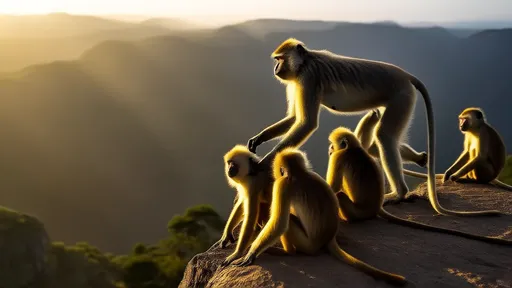
In the dense canopies of tropical forests and across the savannas of Africa, monkeys navigate complex social landscapes that have fascinated scientists for decades. These primates exhibit remarkable forms of collective intelligence that shape their survival, communication, and cultural behaviors. Unlike individual problem-solving seen in many solitary species, monkeys often rely on the accumulated knowledge and coordinated actions of their groups to thrive in challenging environments. Their societies function as dynamic networks where information flows through intricate relationships, creating a tapestry of shared wisdom that has evolved over millions of years.
One of the most striking examples of collective intelligence in monkey societies is their sophisticated communication systems. Vervet monkeys, for instance, have developed distinct alarm calls for different predators. When a leopard is spotted, a specific call sends the group scrambling up trees, while an eagle warning causes them to dive under brush, and a snake alert prompts them to stand bipedally and peer into the grass. This nuanced vocal system represents a shared repository of knowledge about threats, where each monkey contributes to and benefits from the group's understanding of danger. The system isn't perfect from birth—young monkeys learn through trial and error, sometimes giving eagle calls for harmless birds until corrected by elders, demonstrating how knowledge transfers across generations.
Foraging strategies provide another window into primate collective intelligence. Capuchin monkeys in South America employ complex group coordination to access difficult food sources. When encountering hard-shelled nuts, they transport them to specific "anvil" stones where generations have cracked them open. Younger monkeys observe and learn these techniques from older, experienced individuals, creating cultural traditions that persist over time. Similarly, Japanese macaques famously developed the innovation of washing sweet potatoes in seawater, a behavior that spread through their population not through genetics but through social learning, becoming a cultural norm that enhanced their nutritional intake.
Social learning extends beyond mere food acquisition into tool use, particularly among some monkey species. Although not as prolific as apes in tool manipulation, certain monkeys demonstrate impressive instrumental traditions. Thai long-tailed macaques use rocks to crack open oysters and hard-shelled crabs along coastlines, with skilled individuals often drawing observers who subsequently attempt to replicate the techniques. The group collectively maintains and refines these tool-using sites, with knowledge passing from proficient adults to curious juveniles through patient observation and gradual practice. This cultural transmission ensures that valuable survival skills persist beyond individual lifespans.
Conflict resolution within monkey groups reveals another dimension of their collective wisdom. Rather than constantly resorting to violence, many species have developed sophisticated reconciliation behaviors. After disputes, monkeys often engage in grooming, food sharing, or gentle touching—actions that repair social bonds and maintain group cohesion. Baboons, for example, show remarkable flexibility in their social strategies; when aggressive males dominate a group, stress levels rise throughout the troop, but when more socially skilled individuals gain influence, the entire group benefits from reduced conflict and improved cooperation. This collective preference for stability over chaos demonstrates an implicit understanding that social harmony serves everyone's interests.
The collective intelligence of monkeys manifests strikingly in their group decision-making processes. When moving between feeding sites, many species don't follow a single dominant leader but rather reach consensus through a combination of vocalizations, movements, and followership. Studies of hamadryas baboons have shown that movements often begin when multiple individuals orient in the same direction, creating a critical mass that then draws the entire group. This distributed leadership model allows for flexible responses to changing conditions, as different individuals may possess relevant information about predators, food sources, or routes. The group effectively integrates multiple perspectives rather than relying on one potentially flawed leader.
Monkey societies also demonstrate collective intelligence through their division of labor and role specialization. In spider monkey communities, individuals develop reputations based on their skills—some become particularly adept at finding fruiting trees, while others excel at detecting predators or mediating conflicts. The group recognizes and leverages these specialized skills, often following the most knowledgeable individual in relevant contexts. This organic specialization allows the group to benefit from individual expertise while maintaining flexibility—if a key individual disappears, others can compensate, though sometimes at reduced efficiency until knowledge gaps are filled.
The transmission of knowledge across generations represents perhaps the most profound aspect of monkey collective intelligence. Unlike genetically hardwired behaviors, many monkey traditions are culturally maintained through observation, imitation, and teaching. Infant monkeys spend years learning social norms, foraging techniques, and communication systems from their mothers and other group members. This extended learning period allows for the accumulation of knowledge across generations, with each cohort adding innovations and adaptations. In this way, monkey groups build upon the wisdom of their ancestors, creating cultural lineages that sometimes span centuries.
Human impacts on monkey societies are unfortunately demonstrating the fragility of this collective intelligence. As habitat fragmentation disrupts social networks and older, knowledgeable individuals are lost to hunting or habitat destruction, groups can suffer from what anthropologists call "cultural extinction." There are documented cases of monkey groups losing traditional knowledge about medicinal plants, predator avoidance, or foraging techniques when key individuals disappear and the chain of cultural transmission is broken. This phenomenon highlights how collective intelligence depends on social stability and intergenerational continuity.
Recent research has begun to reveal the neurological underpinnings of collective intelligence in primates. Studies using non-invasive imaging have shown that monkeys living in complex social environments develop enhanced neural connectivity in brain regions associated with social cognition, problem-solving, and memory. Their brains literally reflect the cognitive demands of navigating intricate social relationships and group dynamics. This neurological plasticity suggests that collective intelligence isn't merely behavioral but becomes biologically embedded through generations of social living.
The study of collective intelligence in monkey societies offers profound insights not just into primate behavior but into the very nature of intelligence itself. It challenges the notion of intelligence as purely an individual attribute, showing instead how cognitive prowess can emerge from social networks and shared knowledge systems. As we continue to unravel the complexities of how monkeys think together, we gain not only a deeper appreciation for our primate cousins but also valuable perspectives on human social evolution and the foundations of our own cultural achievements.

By /Aug 21, 2025

By /Aug 21, 2025
By /Aug 21, 2025

By /Aug 21, 2025

By /Aug 21, 2025
By /Aug 21, 2025
By /Aug 21, 2025

By /Aug 21, 2025
By /Aug 21, 2025

By /Aug 21, 2025
By /Aug 21, 2025
By /Aug 21, 2025
By /Aug 21, 2025

By /Aug 21, 2025

By /Aug 21, 2025

By /Aug 21, 2025
By /Aug 21, 2025
By /Aug 21, 2025
By /Aug 21, 2025
By /Aug 21, 2025
