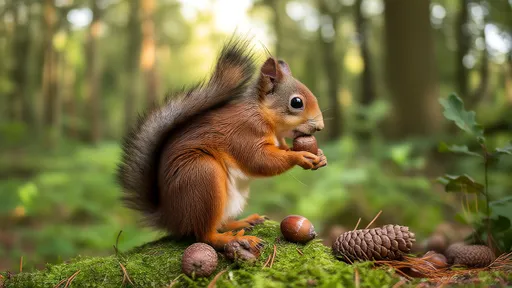
In the quiet rustle of autumn leaves, a familiar sight unfolds across temperate forests worldwide. A small, bushy-tailed creature darts between branches, its cheeks bulging with seeds and nuts. This is not mere hoarding; it is the beginning of a complex ecological relationship that has shaped forest landscapes for millennia. The squirrel, often seen as a playful backyard visitor, is in fact one of nature's most efficient and unwitting foresters, a master of dispersal whose forgetfulness becomes the forest's fortune.
The mechanism is deceptively simple. As autumn approaches, squirrels enter a phase of intense foraging, driven by an instinct to prepare for the scarce months of winter. They spend hours each day collecting acorns, walnuts, hickory nuts, pine cones, and other tree seeds. Using their sharp incisors, they expertly crack open shells to test for quality, often discarding hollow or infested seeds on the spot. The viable prizes are then transported, one by one, to be cached. This is where the story transcends simple animal behavior and becomes a tale of ecological symbiosis.
What is truly remarkable is the strategy behind the caching. Squirrels do not simply pile their treasures in a single, large nest or hollow tree—a larder that would be easily pilfered by competitors or ruined by mold. Instead, they engage in what is known as scatter-hoarding. Each seed is buried individually in a shallow hole dug in the soil, scattered across a territory that can span several acres. A single squirrel can create thousands of these caches in a single season, creating a vast, hidden map of future trees.
The fate of these hidden seeds is what cements the squirrel's role as an ecosystem engineer. Their memory, while impressive, is not infallible. It is estimated that a squirrel fails to recover between 25% to 50% of its scattered caches. These forgotten seeds, nestled in their nutrient-rich, soil-protected graves, are perfectly positioned for germination when spring arrives. The very act of burial protects them from being eaten by other seed predators on the surface and from the desiccating effects of sun and wind. The squirrel has, quite literally, planted a tree.
This relationship is not a one-way street. The trees themselves have evolved to encourage this behavior. Mast years—the phenomenon where trees like oaks and beeches synchronize to produce a massive, overwhelming bounty of seeds every few years—is a evolutionary adaptation directly linked to animals like squirrels. In a regular year, squirrels and other predators might consume nearly all available seeds, leaving none to grow. But in a mast year, the sheer abundance of seeds satiates the predators. Their caches are full to bursting, and millions of surplus seeds are left to be buried and forgotten, ensuring the next generation of trees. The trees have, in a sense, hired the squirrels as their planting agents.
The impact of this tiny forester is profound. By moving seeds away from the parent tree, squirrels combat a major problem in forest regeneration: distance-dependent mortality. Seeds that fall directly beneath their parent tree face intense competition for light, water, and nutrients from the established root system. They are also more susceptible to specialized diseases and insects that thrive in that specific microenvironment. By carrying seeds tens or even hundreds of meters away, squirrels give these saplings a fighting chance, reducing competition and thinning out potential disease. This dispersal promotes genetic diversity and healthier, more resilient forest stands.
Furthermore, the choice of cache location is not entirely random. Squirrels often show a preference for burying seeds at the edges of clearings or in areas with softer, disturbed soil. These microsites often offer ideal conditions for seedling establishment—more sunlight and less root competition than the dense forest floor. Unknowingly, the squirrel is selecting prime real estate for its accidental arboriculture, influencing the very structure and composition of the forest.
This intricate dance of forgetfulness and abundance is a stunning example of a mutualistic relationship forged over eons of coevolution. The squirrel gets a survival strategy, a hidden pantry to see it through the winter. The forest gets a diligent, widespread, and effective propagation service. The next time you see a squirrel darting across a park path with a nut in its mouth, pause for a moment. You are not just watching an animal prepare for winter; you are witnessing a ancient and vital contract being honored, one that helps our forests breathe and grow. It is a humble reminder that in nature, even a forgotten treasure can become a legacy.
By /Aug 21, 2025
By /Aug 21, 2025
By /Aug 21, 2025

By /Aug 21, 2025

By /Aug 21, 2025
By /Aug 21, 2025
By /Aug 21, 2025

By /Aug 21, 2025
By /Aug 21, 2025
By /Aug 21, 2025
By /Aug 21, 2025
By /Aug 21, 2025

By /Aug 21, 2025

By /Aug 21, 2025
By /Aug 21, 2025
By /Aug 21, 2025
By /Aug 21, 2025
By /Aug 21, 2025
By /Aug 21, 2025
By /Aug 21, 2025
