In the intricate world beneath our feet, a sophisticated communication network thrives, one that has evolved over millions of years yet remains largely enigmatic to human observers. Ant colonies, often perceived as simple aggregates of industrious insects, are in fact complex superorganisms governed by an elaborate system of chemical signaling. This system, known as pheromonal communication, represents one of nature’s most fascinating and efficient languages, allowing colonies comprising thousands or even millions of individuals to function with the coordination of a single entity. The study of this chemical lexicon not only unveils the secrets of ant society but also inspires advancements in technology, from networking algorithms to robotics.
The foundation of ant communication lies in the production and detection of pheromones—volatile chemical compounds secreted from glands located throughout their bodies. These chemical signals are as diverse as the messages they convey, ranging from trail pheromones that guide foragers to food sources to alarm pheromones that mobilize the colony for defense. Each pheromone carries a specific meaning, creating a rich vocabulary that dictates nearly every aspect of colonial life, from foraging and nesting to brood care and reproduction. The precision of this system is staggering; for instance, a single ant discovering a sugar droplet can lay a trail that directs hundreds of nestmates to the exact location with minimal error.
What makes this language particularly remarkable is its dynamic and context-dependent nature. Pheromones are not static signals but evolve in meaning based on concentration, blend, and environmental conditions. A trail pheromone, when highly concentrated, might indicate a rich, nearby food source, urging rapid recruitment, while a faint trail could suggest a depleted or distant resource, leading to a more measured response. Similarly, alarm pheromones released in small quantities might cause ants to become alert and investigate, whereas a large release can trigger a frantic, aggressive swarm to repel intruders. This gradation allows for a nuanced exchange of information, akin to tone and emphasis in human speech.
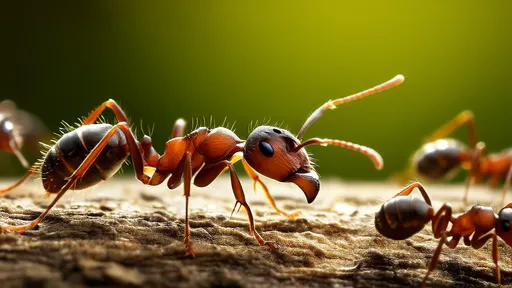
The transmission and reception of these chemical messages are facilitated by the ants’ highly specialized anatomy. Their antennae, equipped with numerous sensilla—microscopic hair-like structures—act as chemical detectors capable of discerning minute variations in pheromone composition and concentration. This sensory prowess enables ants to not only follow trails with astonishing accuracy but also to recognize nestmates, distinguish between castes, and even assess the health and fertility of their queen. The antennae are in constant motion, sampling the chemical landscape, ensuring that each individual is perpetually attuned to the colony’s collective needs and commands.
Beyond simple binary signals, ants utilize complex pheromone cocktails to convey intricate messages. Research has revealed that different glands produce distinct pheromones that, when combined, create a layered meaning. For example, an ant might deposit a trail pheromone from one gland to mark a path while simultaneously secreting a different pheromone from another gland to indicate the type of food found—whether it is protein-rich insect prey or carbohydrate-based nectar. This blending allows for a form of chemical syntax, where the arrangement and mixture of signals generate specific instructions, enabling a level of communication previously thought impossible for insects.
The efficacy of the pheromone language is also a testament to the evolutionary pressures that have shaped it. In the competitive and often hazardous environments where ants thrive, efficiency and speed are paramount. Chemical signals persist in the environment longer than auditory or visual cues might, providing a durable message that can be followed long after the sender has moved on. However, this persistence also presents a challenge: outdated information must be managed to avoid confusion. Ants have evolved behaviors to mitigate this, such as the cessation of trail reinforcement when a food source is exhausted, allowing the pheromone to evaporate and the trail to fade naturally.
Human fascination with this cryptic language has spurred numerous scientific inquiries, employing cutting-edge technologies to decode its mysteries. Gas chromatography and mass spectrometry are used to isolate and identify individual pheromone compounds, while behavioral assays test their effects on ant colonies. These studies have not only cataloged dozens of pheromones but have also revealed surprising complexities, such as the ability of some species to “eavesdrop” on the alarm signals of others, or to use deceptive pheromones in acts of ecological warfare, like the invasion of rival colonies.
The implications of understanding ant communication extend far beyond entomology. Computer scientists have drawn inspiration from the decentralized, efficient problem-solving exhibited by ant colonies, developing ant colony optimization algorithms that solve complex logistical problems, such as routing data through networks or optimizing supply chains. Roboticists, too, are looking to emulate these principles, designing swarms of simple robots that can cooperate through stigmergy—a form of indirect coordination via environmental modification—much like ants leaving and following pheromone trails.
Despite significant progress, the pheromone language of ants remains a domain of vast uncharted territory. Scientists estimate that we have identified only a fraction of the chemical signals used, and the subtleties of how these signals are integrated and interpreted within the colony are still poorly understood. Moreover, the impact of environmental changes—such as pollution or climate shift—on these delicate chemical exchanges is a growing concern, as alterations could disrupt the very foundation of ant societies and the ecosystems they help regulate.
In the grand tapestry of animal communication, the silent, chemical discourse of ants stands as a profound example of evolutionary innovation. It is a language without sounds or gestures, yet it orchestrates the rise and fall of empires, the exploitation of resources, and the defense of territories. As we continue to decipher this ancient and mysterious world, we not only gain insight into the hidden lives of these ubiquitous insects but also uncover fundamental principles of organization, cooperation, and intelligence that resonate across the natural world and into the realms of human technology and thought.
By /Aug 21, 2025
By /Aug 21, 2025
By /Aug 21, 2025
By /Aug 21, 2025
By /Aug 21, 2025

By /Aug 21, 2025
By /Aug 21, 2025

By /Aug 21, 2025
By /Aug 21, 2025
By /Aug 21, 2025
By /Aug 21, 2025
By /Aug 21, 2025
By /Aug 21, 2025

By /Aug 21, 2025

By /Aug 21, 2025

By /Aug 21, 2025
By /Aug 21, 2025
By /Aug 21, 2025
By /Aug 21, 2025

By /Aug 21, 2025
