In the dense foliage of gardens and forests worldwide, a master of ambush awaits its unsuspecting prey. The praying mantis, an insect often admired for its prayer-like stance, is in fact one of nature's most efficient and ruthless predators. Its hunting strategy is not one of brute force or overwhelming speed, but a refined art form built on patience, deception, and a lightning-fast strike. This silent killer operates with a chilling precision that has been perfected over millions of years of evolution, making it a fascinating subject for anyone interested in the complexities of predatory behavior.
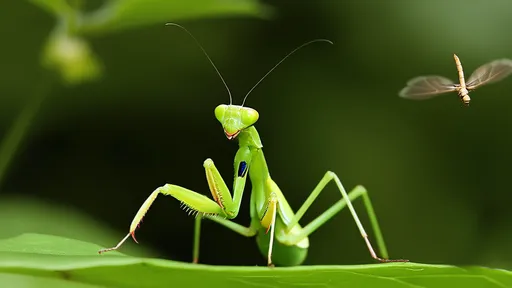
The entire anatomy of the mantis is a weapon honed for its specific role. Its most iconic feature, the powerful raptorial forelegs, are not for walking but for seizing. These legs are folded and held in that characteristic "praying" position, a deceptive posture of quiet contemplation that belies their true purpose. When triggered, they unfold with explosive speed, equipped with rows of sharp spines that act like a living bear trap, snapping shut around the victim with immense force. This mechanism is so effective it can capture and hold insects much larger than the mantis itself. Furthermore, its triangular head is mounted on an incredibly flexible neck, allowing for nearly 180 degrees of rotation. This gives the mantis a panoramic view of its surroundings without moving its body, a critical advantage for an ambush predator that relies on staying perfectly still to avoid detection. Its large, compound eyes are exceptionally adept at detecting movement, enabling it to calculate the exact distance to its target with terrifying accuracy.
Perhaps the most crucial element of the mantis's hunting strategy is its profound and almost supernatural patience. A mantis will choose a prime location—often a flower visited by pollinators or a leaf along a common insect pathway—and then it simply ceases to exist as a moving entity. It becomes a piece of the scenery, a green or brown extension of the stem it clings to. It can remain motionless for hours, even days, waiting for the right opportunity. This extreme stillness is a form of aggressive deception. It is not merely hiding; it is using its environment as a cloak, becoming an indistinguishable part of the background. Many mantis species possess incredible camouflage, with bodies and limbs that mimic leaves, twigs, or even flowers with stunning verisimilitude. This patient vigil is an energy-efficient method, requiring minimal expenditure for a potentially large caloric payoff, a key to survival in the competitive natural world.
The culmination of the hunt is a event of breathtaking speed and finality. The strike is not a pounce or a lunge with its whole body, but a precise and isolated movement of its specialized forelegs. The entire process, from target acquisition to capture, can be over in less than a hundred milliseconds—faster than the human eye can reliably follow. The mantis has already calculated the trajectory during its patient watch. There is no second guess, no hesitation. The forelegs fire outward, and the spiny tibia and femur snap closed, impaling or firmly grasping the prey. The speed ensures surprise and prevents escape, while the strength of the grip ensures the victim cannot break free. Often, the prey is already being consumed before it even ceases struggling, the mantis's powerful mandibles beginning their work immediately. This efficient dispatch minimizes the risk of injury to the mantis from a desperate fight.
While the "sit-and-wait" ambush is its signature tactic, the mantis's hunting repertoire is more diverse than it appears. Some species are known to employ a slow, stalking approach if a potential meal is just out of reach, moving with an almost imperceptibly slow, swaying gait that mimics vegetation moving in a breeze, further enhancing its camouflage. This behavior demonstrates a cognitive ability to assess a situation and adapt its strategy accordingly. Furthermore, mantises are not just insectivores; they are opportunistic and highly ambitious predators. Documented cases show large mantis species successfully preying on small vertebrates like frogs, lizards, hummingbirds, and mice. These feats highlight the incredible power and audacity of this predator, proving that its effective hunting techniques can scale to targets far beyond its insect peers.
The world of the mantis is one of silent calculation and sudden, violent conclusion. It is a predator that has traded the stamina of the chase for the efficiency of the perfect ambush. Its success lies in the seamless integration of its specialized physical tools—its spiked claws, rotating head, and keen eyes—with behavioral mastery in the forms of infinite patience and masterful disguise. It reminds us that in nature, power is not always loud and obvious. Sometimes, it is quiet, still, and disguised as part of the furniture, waiting for the perfect moment to reveal itself in a flash of ruthless efficiency. The praying mantis is not just a hunter; it is a silent artist, and its canvas is the moment of the strike.

By /Aug 21, 2025
By /Aug 21, 2025
By /Aug 21, 2025

By /Aug 21, 2025

By /Aug 21, 2025

By /Aug 21, 2025

By /Aug 21, 2025

By /Aug 21, 2025
By /Aug 21, 2025

By /Aug 21, 2025

By /Aug 21, 2025
By /Aug 21, 2025

By /Aug 21, 2025

By /Aug 21, 2025

By /Aug 21, 2025

By /Aug 21, 2025
By /Aug 21, 2025

By /Aug 21, 2025
By /Aug 21, 2025

By /Aug 21, 2025
