In the stark and unforgiving expanse of the Arctic tundra, where temperatures can plummet to a bone-chilling -40°C and winds howl with relentless fury, survival is a testament to evolutionary genius. Among the few species that not only endure but thrive in this frozen desert is the muskox, a shaggy, prehistoric-looking behemoth. Its very existence is a masterclass in biological engineering, a living fortress designed by millennia of brutal natural selection. This is not merely an animal with a thick coat; it is a perfectly integrated system of thermal regulation, a marvel of insulation and endurance that has captivated biologists and materials scientists alike. Its "anti-cold equipment" offers profound insights into survival in extreme environments, lessons that resonate from the realm of zoology to the cutting edge of human technology.
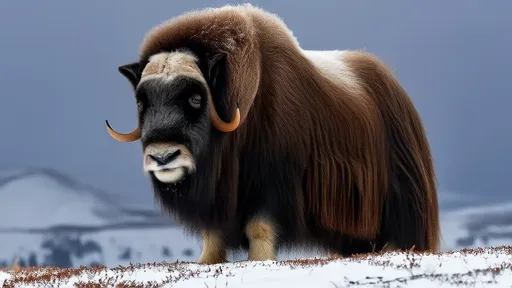
The most iconic feature of the muskox, its first and most formidable line of defense, is its legendary coat. To call it a double-layered coat is an understatement; it is a sophisticated, multi-component insulating system. The outer layer consists of long, coarse guard hairs, known as qiviut in the Inuit language, which can reach lengths of up to three feet, draping over the animal's body like a heavy curtain. These hairs are remarkably strong and hollow, a design that provides exceptional tensile strength to withstand abrasion from rocks and ice while also trapping a layer of stationary air close to the body. This trapped air is the critical element, forming a passive insulating barrier that drastically reduces convective heat loss, effectively creating a personal microclimate around the muskox, impervious to the external cold.
Beneath this protective curtain lies the true secret to the muskox's warmth: a dense, soft, and incredibly fine underwool. This undercoat is so thick that it completely obscures the skin from view. It is composed of a finer fiber than cashmere and is eight times warmer than sheep's wool by weight, making it one of the most effective natural insulators on the planet. This layer works by creating a vast number of tiny air pockets between its countless fibers. Air, being a poor conductor of heat, is trapped within this dense matrix, preventing the animal's metabolic body heat from escaping. The combination of the wind-breaking guard hairs and the supremely insulating underwool creates a synergistic effect, a defense so potent that snow accumulating on the muskox's back will not melt, as virtually no heat is permitted to radiate outward and waste energy.
Beyond its passive insulation, the muskox employs a suite of active and behavioral adaptations to conserve its precious energy reserves. Its compact, barrel-shaped body is a lesson in efficient geometry. With a low surface-area-to-volume ratio, the animal minimizes the amount of skin exposed to the cold air, thereby reducing the overall area through which heat can be lost. Its short, stout legs and ears further limit extremities that are vulnerable to frostbite. In the face of a blizzard, the herd does not flee; it forms a legendary defensive phalanx. Adults circle tightly, presenting a wall of horns and skull to the outside, while the vulnerable calves are pushed into the center of the formation. This collective strategy does more than protect against predators; it creates a shared thermal mass, dramatically reducing the wind chill factor for every individual in the huddle and conserving communal energy.
This profound understanding of the muskox's survival toolkit is not merely academic. It has sparked a field of innovation known as biomimicry, where engineers and designers seek solutions to human problems by emulating nature's time-tested patterns and strategies. The principle of using hollow fibers for insulation and lightness is directly inspired by the muskox's guard hairs. This concept is now applied in the development of advanced synthetic textiles for extreme cold-weather gear, high-performance athletic wear, and even architectural insulating materials. By mimicking the structure that allows the muskox to stand calmly in a polar storm, we can create jackets for Arctic explorers or sleeping bags for mountaineers that are lighter, warmer, and more efficient than ever before.
The muskox's strategy of layering—a tough, weather-resistant outer shell over a dense, air-trapping inner layer—is the fundamental blueprint for all modern technical clothing systems. Furthermore, the social huddling behavior observed in the herd offers a powerful model for energy conservation in human contexts. Urban planners and architects study this concept, thinking about building design and city layouts that minimize wind exposure and create sheltered microclimates, reducing the energy required for heating communities in cold regions. The animal’s physiological feat of reducing blood flow to its extremities to preserve core temperature informs medical protocols for treating hypothermia and frostbite victims.
However, the very adaptations that have ensured the muskox's survival for thousands of years are now being tested by a new and unprecedented threat: rapid climate change. The Arctic is warming at a rate more than twice the global average, leading to increased rainfall in winter. When rain falls on snow and subsequently freezes, it creates impenetrable layers of ice that coat the tundra. For the muskox, this is catastrophic. Their primary food source, buried vegetation, becomes locked away beneath this solid barrier. Their specialized hooves, perfect for scraping through powdery snow, are ineffective against thick ice. This leads to starvation and catastrophic die-offs. Ironicly, the superb insulation that protects them from -40°C cold becomes a liability during unseasonal thaws or increased physical exertion, as they are prone to overheating, a stress that further depletes their energy reserves.
The story of the muskox is a powerful narrative of resilience and exquisite adaptation. It stands as a majestic symbol of life's ability to conquer one of Earth's most hostile environments through a combination of impeccable personal equipment and intelligent social strategy. Its biological design principles continue to inspire human innovation, pushing the boundaries of material science and design. Yet, it also serves as a stark and sobering warning. The creature that perfected survival in the deep freeze is profoundly vulnerable to the erratic weather and warming temperatures brought on by a changing climate. The muskox, a timeless testament to evolutionary triumph, has now become an unwitting sentinel, signaling the profound disruptions facing the fragile ecosystem it calls home. Its future survival depends not just on its ancient adaptations, but on the global actions taken to preserve the stability of its extreme world.
By /Aug 21, 2025
By /Aug 21, 2025
By /Aug 21, 2025
By /Aug 21, 2025
By /Aug 21, 2025
By /Aug 21, 2025
By /Aug 21, 2025
By /Aug 21, 2025
By /Aug 21, 2025
By /Aug 21, 2025
By /Aug 21, 2025
By /Aug 21, 2025

By /Aug 21, 2025

By /Aug 21, 2025
By /Aug 21, 2025
By /Aug 21, 2025
By /Aug 21, 2025
By /Aug 21, 2025
By /Aug 21, 2025
By /Aug 21, 2025
